Published: 07/15/2026
By Catherine Wu, Global Health Communications Assistant
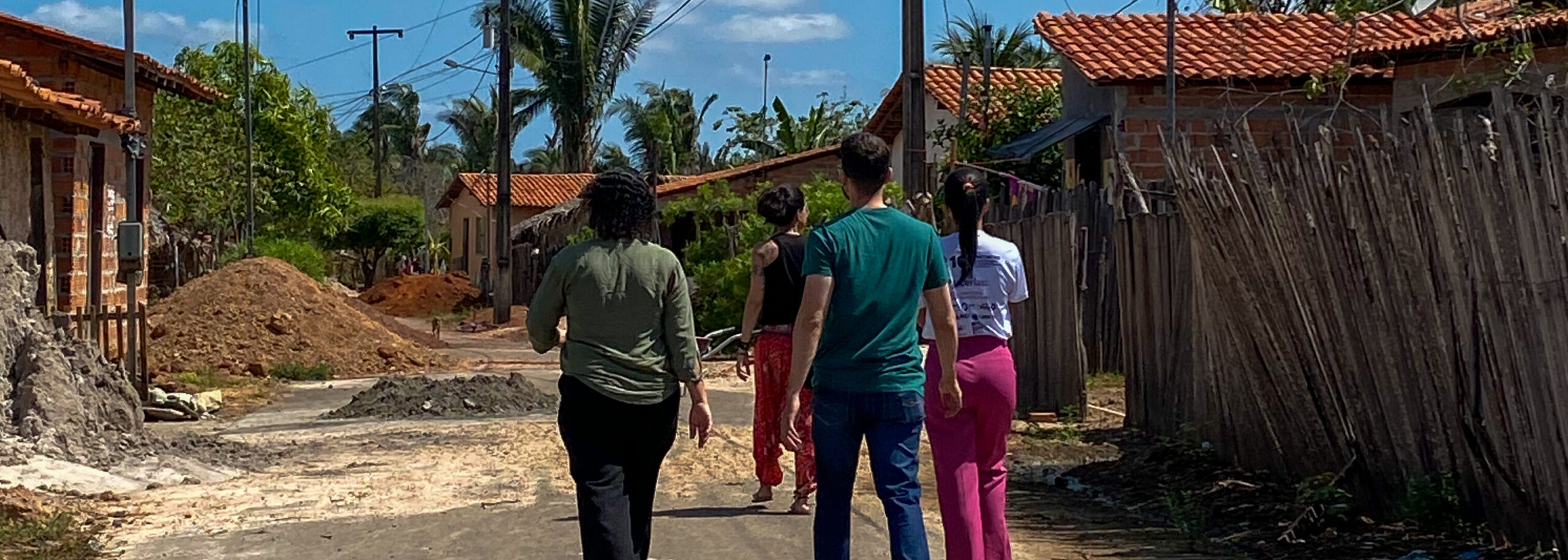
Photo: Research collaborators from the Centro de Defesa da Vida e dos Direitos Humanos Carmen Bascarán (CDVDH/CB) and Ori Consultoria visit impacted communities in Maranhão, Brazil. Photo courtesy of CDVDH/CB.
In recognition of World Day Against Trafficking in Persons on July 30, the Stanford Center for Innovation in Global Health (CIGH) hopes to call attention to the estimated 50 million people in modern slavery.
At Stanford, a three-year research collaboration in Brazil is shining a light on the crucial need for sustained mental health care for survivors — and exploring innovative ways to provide it.
In 2023, an interdisciplinary team at the Stanford Human Trafficking Data Lab launched a project to improve mental health outcomes for survivors of human trafficking in Brazil through community collaborations. They set out to investigate something underexamined in the anti-trafficking field: whether peer counseling delivered by fellow survivors could improve mental health outcomes for trafficking survivors. Supported by a Global Health Seed Grant from the CIGH, this project focused on Maranhão, one of Brazil’s highest-risk regions for exploitation, and partnered with the Brazilian nonprofit Centro de Defesa da Vida e dos Direitos Humanos Carmen Bascarán (CDVDH/CB).
The team included principal investigators Grant Miller, PhD, Henry J. Kaiser, Jr. professor in the Department of Health Policy at Stanford’s School of Medicine and a senior fellow at the Freeman Spogli Institute for International Studies and the Stanford Institute for Economic Policy Research, and Mike Baiocchi, PhD, associate professor of epidemiology and population health. They were joined by Victoria Ward, MD, Kimberly Babiarz, PhD, and Jessica Brunner, MA. They built a WhatsApp-based peer counseling and check-in system to provide survivors with mental health services as an integral part of post-trafficking care. The program connected survivors to layperson counselors and survivor advocates for support through phone and text, following initial in-person meetings to establish trust.
The team believes mental wellness can be a protective factor in reducing the potential for exploitation and re-trafficking. “Being more holistically healthy, physiologically and mentally, can offer survivors some protection against re-trafficking,” said Brunner, who is associate director of strategy and program development and director of human trafficking research at the Stanford Center for Human Rights and International Justice. “Just as with physiological health care, mental health care can benefit us all.”
Being more holistically healthy, physiologically and mentally, can offer survivors some protection against re-trafficking. Just as with physiological health care, mental health care can benefit us all.
– Jessica Brunner, associate director of strategy and program development and director of human trafficking research at the Stanford Center for Human Rights and International Justice
The team ran into some initial challenges, including a lack of validated mental health questionnaires adequately adapted to the Brazilian context, as well as geographical barriers.
Survivors are a highly dispersed and often very mobile population. Their homes were spread over a large area that took hours to reach on countryside roads, said Babiarz, who is a senior research scholar in health policy and the research director of the Stanford Human Trafficking Data Lab.
“Our teams had to first find survivors, then knock on people’s doors to figure out what they needed and then initiate the counseling program,” Babiarz said. “It was very difficult to create the trusting relationship needed for effective counseling.”
This led the researchers to experiment with embedding social workers from CDVDH/CB at the point of rescue, rather than waiting until after victims returned home. “That is the point at which the need is most acute,” Babiarz continued, adding that this is a pivotal time to establish a trusting relationship between peer counselors and victims.
Not surprisingly, task force operations prioritize a criminal justice focus to support future prosecution. As a result, tending to the physical and emotional needs of the victim may be seen as secondary. The team sought to address this.
“Often, no one was specifically responsible for making sure people had clothes, some food, somewhere to go at night,” said Babiarz.
Working with CDVDH/CB to ensure that social workers were on site during task force operations, they found the social workers’ presence improved the ability to identify survivors’ immediate needs, such as food, shelter, and clothing, and set them up better for longer-term, more comprehensive care. This, in turn, helped establish a basis of trust between survivors and caregivers on which mental health support could begin.
Once social workers made contact at the point of rescue, researchers found that the survivors who moved into the WhatsApp-based peer counseling program stayed engaged for longer, up to six months. Through the app, peer counselors — laypeople with lived experience trained to provide first-line emotional support — communicated with survivors through structured check-ins as well as unstructured, ongoing conversations. The team also used the same WhatsApp channel to evaluate their effort through culturally appropriate mental health surveys.
Their findings reveal a broader gap in how trafficking survivors are supported. About half of survivors experience adverse psychological effects after exploitation, according to Ward, yet mental health is rarely treated as core to recovery. According to a report about the project, survivors often contend with PTSD and depression — conditions that can make it difficult to navigate life after trafficking, including securing employment. Furthermore, in Brazil, as in many places around the world, survivors don’t receive systematic social support and must actively seek services on their own.
“Meeting health-related social needs is one of the most important first steps to being able to create stability in their lives,” said Ward, who is a clinical associate professor of pediatrics. “Across communities, whether in Brazil or anywhere in the world, that has to be a prioritized investment.”
Meeting health-related social needs is one of the most important first steps to being able to create stability in their lives. Across communities, whether in Brazil or anywhere in the world, that has to be a prioritized investment.
– Victoria Ward, clinical associate professor of pediatrics
The team is now advocating for social workers to be included in task force operations as standard practice in Brazil and more broadly. Their next step is to use their evidence to build the case for embedding social workers into rescue operations in Brazil and more widely, and demonstrate that treating mental health is inseparable from anti-trafficking work.
Stanford Human Trafficking Data Lab’s commitment to this work extends beyond Maranhão. Their recent work in remote detection of labor trafficking sites in Brazil’s Amazon has helped prosecutors uncover nearly 200 previously hidden charcoal production sites tied to deforestation-driven slavery. This led to a tenfold increase in workers rescued from conditions of modern slavery in that sector.
This commitment to data-driven counter-trafficking efforts carries forward to the team’s newest project. This year, the lab was awarded a follow-up Global Health Seed Grant for an upcoming project: The Unintended Human Cost of Global Conservation: Modern Slavery in Brazil’s Arc of Deforestation. This new project further reflects the team’s commitment to the idea that eradicating trafficking requires more than advancing prosecution and protection; it also requires attention to the systems that make exploitation possible in the first place.